Space Watch
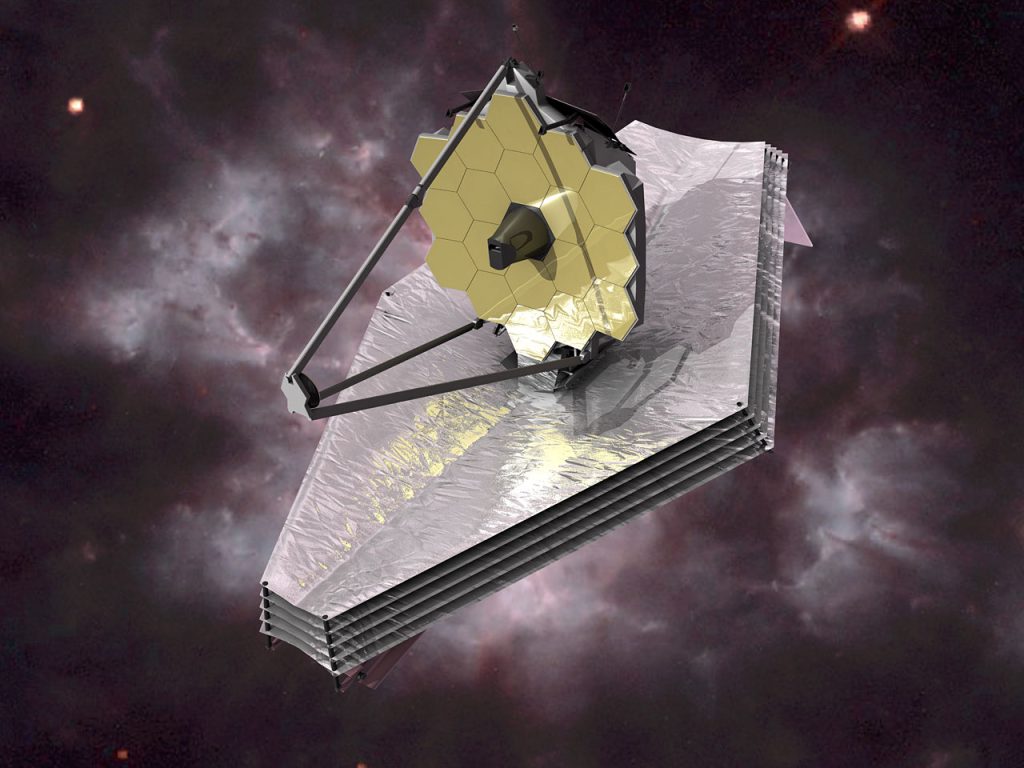
The James Webb Space Telescope (JWST) is one of the most advanced and powerful orbital telescopes mankind has launched into space. Launched on December 25th 2021, the JWST currently sits at LaGrange Point 2 and has been consistently observing the galaxy and taking pictures of it’s discoveries. Compared to the Hubble Space Telescope, the JWST is designed for infrared astronomy and its mirror is much larger than Hubble’s. This allows the JWST to not only see further out in the galaxy than Hubble but also with much more accuracy and clarity as well as seeing far back into our galaxy’s past. A few months after JWST had arrived at L2 the world was treated to an amazing collection of space imagery collected by Webb. In 2022 people all around the world got to see beautifully detailed pictures of previously discovered nebulas in a quality never-before-seen.
Recently, the JWST examined the remains of a supernova star, Cassiopeia A. The supernova exploded about 340 years ago. It is about 11,000 light years from Earth. With its near-infrared camera (NIRCam) and mid-infrared Instrument (MIRI), the telescope was able to show the supernova in a level of detail impossible from previous telescopes. The released images show a halo of red and orange gases expanding outward from the original star and colliding with the surrounding stellar bodies. Eventually, in millions of years, these elements will settle and form new stars and solar systems.
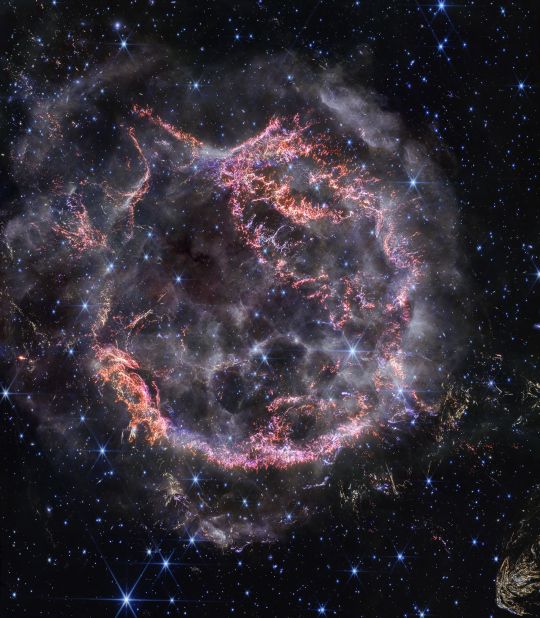
Another noteworthy discovery is a large light echo that scientists are calling ‘Baby Cas A’. A light echo occurs when light from the supernova meets stellar dust and begins to cool off from the explosion. Being able to see the inner shell of the supernova is giving NASA scientists new insights into how stars go supernova and their effects on space.
References:
NASA. “NASA’s Webb Stuns With New High-Definition Look at Exploded Star.” nasa.gov, https://www.nasa.gov/missions/webb/nasas-webb-stuns-with-new-high-definition-look-at-exploded-star/. Accessed 14 December 2023.